

What are safe balance and resistance exercises for adults over 60 to prevent falls?
Evidence-based balance and resistance exercises for adults 60+ to prevent falls, with safety checks, progressions, at-home tests, and PAR-Q guidance.
For general information only — not medical, dietary or legal advice. Talk to a qualified professional about your situation.
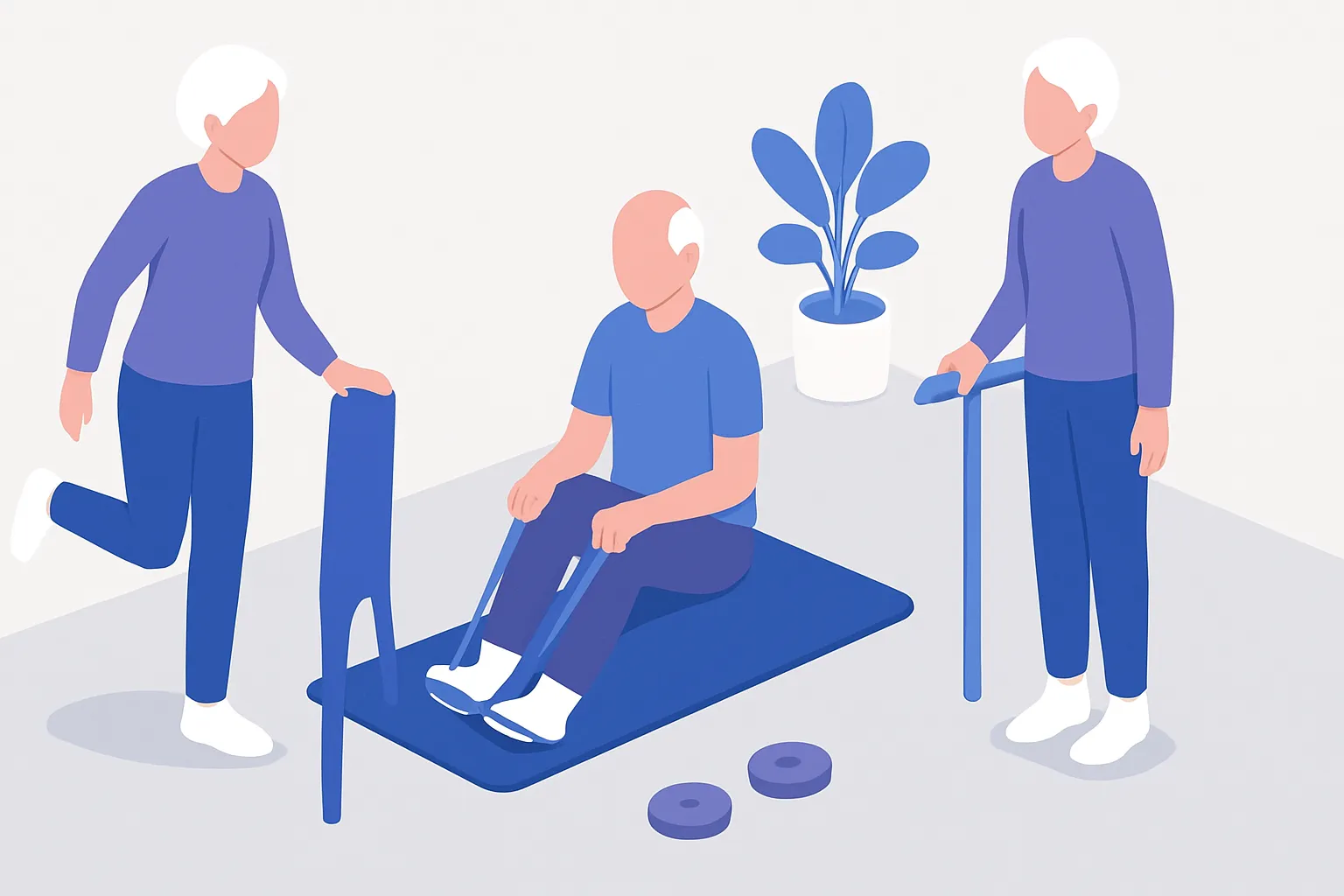
Safe balance and resistance exercises for adults over 60 include chair-supported static holds, dynamic weight shifts, and simple strength moves for legs and trunk. For fall prevention in seniors, combining balance exercises with progressive resistance training is more effective than either alone. Begin only after a brief safety screen and with a stable support.
Last updated: November 2026
Important: This article is for educational purposes only—not medical, dietetic, or legal advice. Verify local scope-of-practice rules. Seek medical clearance if you have health concerns before starting exercise.
Safe balance exercises to start now
Evidence supports balance and functional exercises for reducing falls in community-dwelling older adults. Start with stable, chair-supported drills and progress as control improves. Keep eyes open initially, breathe normally, and stop if you feel dizzy. Johns Hopkins Medicine provides clear, beginner-friendly examples you can practice at home.
- Chair-supported weight shifts (side-to-side, forward–back)
- Heel-to-toe (tandem) stance holding a countertop; begin with semi-tandem, then progress
- March-in-place while lightly holding a chair
- Heel-to-toe walking along a line with support as needed
- Single-leg stance with a fingertip on a surface; reduce support over time
Reference examples: Johns Hopkins Medicine fall prevention exercises.
Strength moves that help prevent falls
Lower-body and trunk strength improve stepping reactions, stair negotiation, and chair rises by increasing force production and postural control, reducing fall risk. Start with bodyweight, then add bands or light dumbbells as technique stabilizes. Emphasize slow, controlled tempo and full pain-free range of motion.
- Sit-to-stands from a chair; progress to goblet squats
- Step-ups to a low step; progress height cautiously
- Heel raises (double-leg → single-leg with support)
- Hip hinges (hip hinge to dowel → deadlift pattern with light load)
- Resistance band rows (seated or standing)
- Farmer’s carry with light objects for grip and postural control
Guidance on frequency appears in the section on training dose below (CDC Guidelines; ACSM overview).
How to progress safely over 12 weeks
Progress comes from small, trackable changes: narrowing stance, reducing support, adding light load, increasing range, or adding time-under-tension. Progress only one variable at a time, keeping breathing steady and posture tall.
- Weeks 1–4: Stable base, two hands for support, bodyweight only; practice 2–3 balance drills and 3–5 strength moves.
- Weeks 5–8: One-hand support; add light bands or 1–3 kg dumbbells; narrow stance.
- Weeks 9–12: Finger-touch support or no support; slightly higher step or load if form remains solid.
Example 1 (standard): Start with 2 sets of 8–10 sit-to-stands and 2 sets of 20–30 second tandem holds, then add a third set or mild load when the work feels comfortably repeatable.
Example 2 (uses a walker or asymmetric leg strength):
- Weeks 1–4: Wider stance; practice near a fixed countertop. For sit-to-stands, use armrests and a higher seat; lightly offload the less-strong leg using the hands as needed.
- Weeks 5–8: Transition to one-hand support on the counter or a stabilized walker; introduce staggered-stance holds with the stronger leg slightly forward; add mini step-backs instead of step-ups.
- Weeks 9–12: Narrow stance to hip-width; use fingertip support; begin low step-ups leading with the stronger leg but cue even weight through both legs. Keep load symmetrical (two light dumbbells) to avoid overloading one side.
Worked reassessment scenario (30-Second Chair Stand triggers — example):
- If you score ≤6 reps, keep bodyweight only and use a higher chair; aim to add 1–2 reps over 2 weeks.
- When you reach 8–10 reps with steady form, add a third set or 1 kg total load.
- At 12+ reps for two consecutive sessions, narrow stance or raise seat-to-stand speed slightly while keeping control. Retest every 2–4 weeks under the same conditions.
Safety checks before you begin
A brief pre-participation screen helps spot red flags. The PAR-Q+ is an internationally recognized self-screening tool that reduces unnecessary exclusions while flagging conditions needing medical input. Complete it before starting or progressing.
- Use: PAR-Q+ (2025) form
- If PAR-Q+ indicates further guidance, consult a clinician first
- Home setup: wear supportive, non-slip footwear; clear rugs, cords, and clutter; secure pets; ensure bright, even lighting; keep a phone within reach
- Keep a stable support (chair/counter) within reach for balance drills; avoid relying on a rolling device unless stabilized
- Stop if you experience chest pain, severe shortness of breath, or vertigo
Learn more safety resources: CDC STEADI clinical resources.
How often to train balance and strength
Major health bodies advise weekly aerobic activity, plus strength and balance work for older adults, especially those at risk of falling. Balance training should be integrated several days per week, and muscle-strengthening should cover major muscle groups on at least two days.
- Aerobic: 150 minutes/week moderate (or 75 minutes vigorous), accumulated in any schedule
- Strength: 2+ days/week covering all major muscle groups
- Balance: Specific activities on 3+ days/week if you’re at fall risk
See: CDC Guidelines for Older Adults and ACSM summary for older age.
Simple at-home fall-risk self-checks
Consistent, standardized tests help you and your coach decide when to progress. Perform these only in a safe setup with a sturdy chair/surface and a helper if needed.
- 30-Second Chair Stand: Count full sit-to-stands in 30 seconds (test description).
- 4-Stage Balance Test: Hold each stance up to 10 seconds—side-by-side, semi-tandem, tandem, single-leg (how-to).
- Timed Up and Go (TUG): Stand, walk 3 meters, turn, return, and sit; time the task (protocols appear in CDC STEADI resources).
Record conditions (shoes, hand support) the same way each time.
If you cannot complete the tests: where to start and when to retest
If you cannot do one sit-to-stand without arms, start with assisted sit-to-stands using armrests and a higher seat, or partial range (lift 5–10 cm, then sit). If you cannot hold tandem stance for 10 seconds, begin with side-by-side stance only and short (5–10 second) holds. Retest every 2–4 weeks or when you complete 3 sets of 8 assisted sit-to-stands and 3 sets of 20-second side-by-side holds with steady control.
What the evidence says about reducing falls
Large systematic reviews show exercise reduces fall rates in community-dwelling older adults, with the largest effects when balance training is combined with progressive resistance work. Tai chi also helps, though typically to a lesser extent.
| Exercise approach | Effect (RaR; 95% CI; participants) | Evidence certainty | Source |
|---|
| Overall exercise programs | RaR 0.77; 95% CI 0.71–0.83; 23,407 participants | High | Cochrane review / PubMed | Balance & functional exercises alone | RaR 0.76; 95% CI 0.70–0.81; subgroup (overall n=23,407) | High | Cochrane review | Multicomponent (balance + progressive resistance) | RaR 0.66; 95% CI 0.50–0.88; subgroup (overall n=23,407) | Moderate | Cochrane review | Tai chi | RaR 0.81; 95% CI 0.67–0.99; subgroup (overall n=23,407) | Low | Cochrane review
Structured physical activity also reduces the risk of fall-related injuries by 32%–40%, based on guideline evaluations (ACSM overview). Tailored, supervised programs tend to outperform unguided routines, according to abridged Cochrane communications (Cochrane news overview).
How Bzzat helps
Bzzat helps coaches deliver and monitor safe active-aging programs. Coaches create training plans, track progress and body measurements, and message trainees. Studios can require a health declaration before booking. Trainees receive push notifications and view plans in the Bzzat app. Attendance and reminders support consistency across sessions. Bzzat does not generate AI exercise modifications, track wearable data, or replace clinical functional assessments—coaches design and adjust programs based on their professional judgment.
Frequently asked questions
Do I need a cane or walker for balance exercises?
Use your current assistive device if prescribed. For drills, keep a stable support (chair or counter) within reach. As balance improves, reduce reliance gradually while staying inside a safe, pain-free range. If you are unsure, complete the PAR-Q+ and ask a clinician before changing supports.
What if my knees hurt during sit-to-stands?
Reduce the range (higher seat), slow the tempo, and keep your knees tracking over mid-foot. Try fewer reps with more rest. If pain persists, switch to partial sit-to-stands or supported box squats and consult a clinician if symptoms continue or worsen.
Can tai chi replace my balance drills?
Tai chi improves balance and can reduce falls, but evidence suggests the largest fall-rate reductions occur when balance work is combined with progressive resistance training. Many older adults do both: short daily tai chi practice plus twice-weekly strength sessions and regular balance drills.
How fast should I progress weights?
Increase only one variable at a time—load, sets, or stance difficulty—and only when you can complete the current program with stable posture and controlled tempo. Small jumps (for example, 0.5–1 kg per dumbbell) are usually sufficient; prioritize technique over load.
Frequently asked questions
Do I need a cane or walker for balance exercises?
Use your current assistive device if prescribed. Keep a sturdy support within reach for drills. As balance improves, reduce assistance gradually while staying in a safe, pain-free range. If unsure, complete the PAR-Q+ and consult a clinician before changing supports.
What if my knees hurt during sit-to-stands?
Shorten the range (use a higher chair), slow the tempo, and keep knees over mid-foot. Do fewer reps with more rest. Switch to partial sit-to-stands or supported box squats, and seek clinical input if pain persists or worsens.
Can tai chi replace my balance drills?
Tai chi helps balance, but the greatest fall-rate reductions occur when balance work is combined with progressive resistance training. Many people pair brief tai chi practice with twice-weekly strength and regular balance drills.
How fast should I progress weights?
Change only one variable at a time—load, sets, or stance difficulty—after you can perform current work with stable posture and control. Make small load increases (for example, 0.5–1 kg per dumbbell) and prioritize technique over intensity.
Sources
- Exercise for preventing falls in older people living in the community
- Exercise for preventing falls in older people living in the community (Sherrington et al., 2019)
- Physical Activity Guidelines for Older Adults
- ACSM: Physical activity and function in older age
- CDC STEADI Clinical Resources
- PAR-Q+ (2025) Form
- Johns Hopkins Medicine: Fall Prevention Exercises
- 4-Stage Balance Test
- Cochrane News: Review on exercise for preventing falls
- 30-Second Chair Stand Test protocol